Some stones get pigeonholed. They become associated with a particular aesthetic or a particular moment in popular culture, and that association starts to obscure what the material actually is. Rose quartz has experienced this more than most. It has been part of wellness trends, interior design waves, and social media aesthetics — all of which have brought it wider recognition but have also, in some circles, created the impression that it is a decorative novelty rather than a serious natural material.
That impression is not accurate. Rose quartz is among the most consistently interesting stones to work with — not because of its cultural moment, but because of its genuine physical qualities. The colour is soft and complex in ways that no manufactured pink material replicates. The translucency is distinctive. The way it responds to light — both holding it and diffusing it — gives finished pieces a quality that requires no storytelling to justify. At Anjili Stones Crafts, it is a material we return to consistently, and for reasons that have nothing to do with trends.
This piece is our account of what this stone actually is, where it comes from, what makes good material worth choosing, and how it performs across the applications where it is most commonly used.
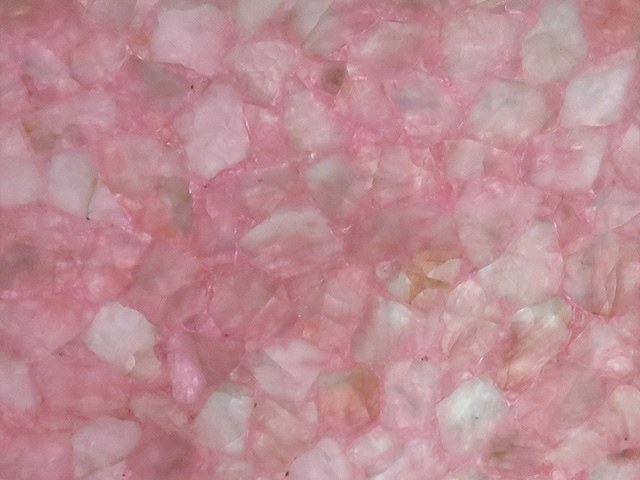
Rose quartz is a variety of crystalline quartz — silicon dioxide — distinguished by its characteristic pale to medium pink colour. Unlike most coloured gemstone varieties where the colour comes from trace amounts of a single, clearly identified impurity mineral, the colour of rose quartz has been the subject of scientific investigation for decades and is now understood to result from microscopic fibrous inclusions of a silicate mineral — most likely a dumortierite-related phase — within the quartz crystal matrix.
These inclusions are submicroscopic: too small to be visible individually even under most magnifying instruments. Their presence within the quartz causes light to scatter and interact in a way that produces the characteristic soft pink colour. This is also why the stone is typically translucent rather than transparent — the density of these inclusions prevents light from passing cleanly through the crystal without interaction.
This colour mechanism has one important practical consequence: rose quartz cannot be irradiated or heat-treated to produce its characteristic colour in the way that some other quartz varieties can be artificially coloured. The pink colour of genuine specimens is natural and intrinsic to the stone’s physical structure. This is one of the clearest distinctions between this stone and pink quartz — a separate, rarer variety that occurs as distinct crystals and owes its colour to a different mechanism involving phosphate inclusions and aluminium impurities. Both are natural; they are simply different things.
In a market where treatment and enhancement are common across many stone types, the fact that rose quartz colour is genuinely natural — not dyed, not irradiated, not coated — is worth noting. At Anjili Stones Crafts, we are always transparent about material treatment across our range, and with this stone, there is typically very little to disclose.
“Crafted with Passion, Shaped by Nature.”
Copyright © Anjili Stones Crafts | All rights reserved.
WhatsApp us