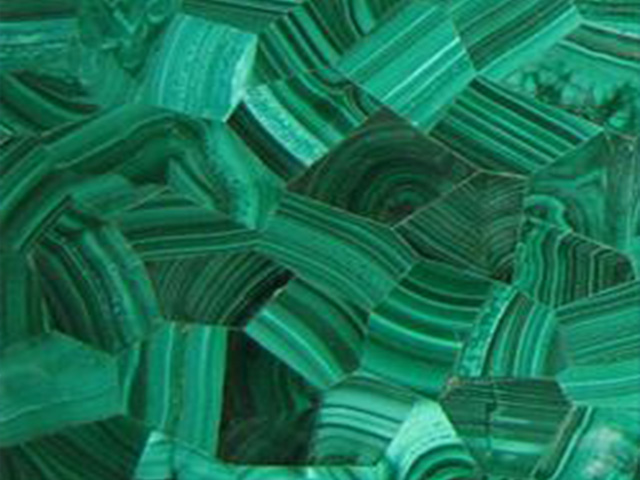
There are stones that need to be explained before they can be appreciated, and there are stones that speak for themselves. Malachite belongs firmly to the second group. The banding — those concentric rings and swirling patterns of deep and pale green — is immediately recognisable, immediately striking, and entirely natural. No two pieces are the same. Every cut surface reveals a different arrangement of the same fundamental pattern, as though the stone is capable of endless visual improvisation within a single, consistent visual vocabulary.
At Anjili Stones Crafts, malachite is one of the stones that generates the most immediate response from people encountering it for the first time. This piece explains what it is, where it comes from, what makes a piece worth choosing, and how it performs across the applications where it is most commonly used.
Malachite is a copper carbonate hydroxide mineral — chemically expressed as Cu₂(CO₃)(OH)₂ — that forms as a secondary mineral in the oxidised zones of copper ore deposits. It is not a silicate like quartz or agate; it is a carbonate mineral, and that distinction matters for how it behaves practically. Its hardness of 3.5 to 4 on the Mohs scale makes it significantly softer than most gemstone materials, which has important implications for care and use.
The green colour is intrinsic — it comes directly from the copper in the mineral’s chemical formula. Copper carbonate is green, and its colour is simply the visual expression of its chemistry. No treatment, no dyeing, no external colouring agent is involved. The particular shade of green — ranging from a soft, pale mint through vivid emerald to deep, almost bottle green — depends on the specific formation conditions and the mix of fine and coarse crystal structures within the stone.
What makes this stone visually distinctive is its banding. It typically forms as botryoidal masses — rounded, grape-like aggregates — or as stalactitic formations where successive layers of material build up in concentric rings. When these formations are cut and polished, the cross-section reveals the layered structure as banding: concentric arcs, swirling waves, eyes within eyes, lines that curve and intersect in ways that look almost intentionally designed. This patterning is entirely the result of natural mineral growth, and it varies dramatically from specimen to specimen and even across different sections of the same piece of rough.
“Crafted with Passion, Shaped by Nature.”
Copyright © Anjili Stones Crafts | All rights reserved.
WhatsApp us