Very few natural materials carry the weight of history that lapis lazuli does. This is a stone that has been mined, traded, carved, and treasured for more than six thousand years. It coloured the pigments of medieval European paintings. It was ground into ultramarine, the most prized and expensive blue available to painters for centuries before synthetic alternatives existed. It adorned the burial objects of Egyptian pharaohs. It travelled the ancient trade routes between Afghanistan and the Mediterranean, carried as cargo alongside gold and silk.
None of this history is incidental. It tells you something real about what this stone actually is: a material of genuinely striking visual character, durable enough to survive millennia, rare enough to be worth transporting across continents, and distinctive enough to be immediately recognisable in any form and any context.
At Anjili Stones Crafts, lapis lazuli is one of the stones we approach with the most care — both because its quality range is wide and because the decisions made in sourcing and finishing have a direct and visible impact on the quality of the finished piece. This piece is our honest account of the stone: what it is, where it comes from, what distinguishes fine material from lesser, and how it performs across its many applications.
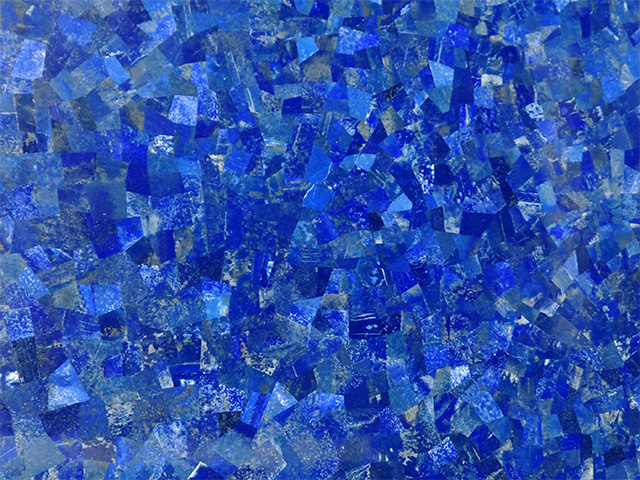
Lapis lazuli is not a single mineral but a rock — a naturally occurring aggregate of several minerals whose combined presence creates the characteristic deep blue appearance. The primary blue colouring mineral is lazurite, a complex aluminium silicate containing sulphur, which is responsible for the stone’s signature ultramarine to royal blue colour. Lazurite content in finished lapis lazuli typically ranges from around 25 to 40 percent by volume, and the intensity and evenness of blue in a given piece is directly
related to the concentration and distribution of lazurite within it.
The other minerals present in lapis lazuli include calcite — which appears as white patches or veining in the finished stone — and pyrite, which appears as bright, metallic gold flecks scattered through the blue matrix. These three components — the deep blue of lazurite, the white of calcite, and the gold of pyrite — are what give lapis lazuli its distinctive character. The relative proportions of these components, and how evenly they are distributed, determines the quality grade of any given piece.
Understanding this composition is essential for evaluating quality in this stone. A piece with a high, even concentration of lazurite and minimal calcite is the most sought-after material. A piece with significant white calcite patches is considered lower quality for most applications, though in some decorative contexts the calcite veining can be visually interesting in its own right. Pyrite — the gold flecks — is generally considered desirable in moderate amounts: enough to add visual character without overwhelming the blue. Pyrite-free material exists and is sometimes preferred for colour-critical applications, but for most decorative and jewellery uses, good pyrite distribution adds rather than subtracts from the piece’s appeal.
“Crafted with Passion, Shaped by Nature.”
Copyright © Anjili Stones Crafts | All rights reserved.
WhatsApp us